Monday, October 19, 2009

"See that you all follow the bishop, even as Jesus Christ does the Father..." - St. Ignatius of Antioch

Beautiful Pictures of Archbishop Raymond Burke's Solemn Pontifical Mass in the Chapel of the Blessed Sacrament at St. Peter's Basilica in Rome! 


From the Blog RINASCIMENTO SACRO

Commemorating St. Peter of Alcantara

"PETER, while still a youth, left his home at Alcantara in Spain, and entered a convent of Discalced Franciscans. He rose quickly to high posts in the Order, but his thirst for penance was still unappeased, and in 1539, being then forty years old, he founded the first convent of the "Strict Observance." The cells of the friars resembled graves rather than dwelling-places. That of St. Peter himself was four feet and a half in length, so that he could never lie down; he ate but once in three days; his sack-cloth habit and a cloak were his only garments, and he never covered his head or feet. In the bitter winter he would open the door and window of his cell that, by closing them again, he might experience some sensation of warmth. Amongst those whom he trained to perfection was St. Teresa. He read her soul, approved of her spirit of prayer, and strengthened her to carry out her reforms. St. Peter died, with great joy, kneeling in prayer, October 18, 1562, at the age of sixty-three."

- Lives of the Saints, by Alban Butler (1894 edition)


Statue of St. Peter of Alcantara in St. Peter's Basilica

Sunday, October 18, 2009

"His mercy is from generation unto generations to them that fear Him." - Luke 1: 50


Detail of Madonna del Magnificat by Sandro Botticelli


    "Each of the Gospels has its own particular characteristic. If one is seeking signs of Our Lord's infinite mercy, he should especially read the Gospel of Saint Luke.
    In this Gospel we find the detailed narratives of the conversion of Magdalen, Zaccheus, and the Good Thief. We see the Good Shepherd seeking the lost sheep and carrying it on His shoulders back to the sheepfold. We see the woman lighting a lamp and looking for her drachma; we learn that this woman's joy in finding it is only a faint image of the joy of God and His Angels when a sinner converts. We also admire the goodness of the father of the prodigal son upon the return of his child, the compassion and liberality of the Good Samaritan. We see Jesus Himself, moved by the widow of Naim who was crying over the death of her son. We see His goodness when He speaks with the disciples of Emmaus after His Resurrection; He enlightens them, comforts them, then allows them to recognize Him.
    Saint Anselm says that Saint Luke the Evangelist, having previously been a physician, had devoted his efforts to relieving sicknesses of the body. After he became a disciple of the Lord, he devoted them to relieving sicknesses of the soul. And the great remedy for sickness of the soul is God's mercy, which delivers the soul of its sins. Saint Luke kept clearly in mind Mary's words, which proclaim the greatness of Divine mercy.
    This mercy consists in the benefits God has poured forth at all times and will pour forth until the end upon His faithful servants, especially the benefits of the Incarnation of the Word, the Redemption, the
Eucharist, and all the graces that derive from these sacred mysteries. This mercy is not for a time but for all times, although it is not manifested in every era with equal abundance. Saint Albert the Great says, "It is great, it is continual, it is abundant, it is sweet, it is discreet." Divine mercy is also patient; it does not allow the justice and the wrath of God to act as soon as the sinner makes himself guilty, but waits for him to return to a better disposition and do penance.
... 
    Does Our Lord not teach us that God's mercy and His perfection are one and the same thing? Listen to what He tells us in the Gospel of Saint Matthew: Be perfect as your heavenly Father is perfect . . . He who makes His sun rise on the good and the evil, and sends rain on the just and the unjust. [ St. Matthew 5: 48,45] Is it not in this goodness, which is extended to everyone, that Jesus Christ says the Father's perfection consists? Listen to Saint Luke, who relates the same teaching of the Lord in other terms: Be merciful, even as your Father is merciful. [St. Luke 6: 36]
...
    If we do not fear God, if we refuse to keep His Commandments, how will we be able to lift up our eyes to the Mother of mercy? What can Mary do for a soul in open revolt against Jesus Christ, Her Son and our Judge, a soul that refuses to bow beneath His authority and defies Him? She has fore- warned us Herself that mercy is reserved for those who fear God. Do we think Mary will approve of our iniquities? She is very willing to implore our forgiveness and obtain our return to God's favor, but She will do so only if we manifest a sincere will to revert to the good, and regret having separated from God and having offended Him. Mary has an infinite horror for sin; She can help only pure souls draw near to Him, or those who implore Her help to become pure. Let us not approach Mary if we are burdened with sin, Her mortal enemy. Or if that enemy is wound around us like a deadly serpent, let us call Mary to our help, but let it be in order to be delivered from it. Then we will have a right to Her assistance; through Her we will obtain precious graces for this life and final perseverance in view of eternity."

- Excerpts from Somme des Grandeurs de Marie, Sermons sur Ie Magnificat, Vol. VII.Abbe Z.C. Jourdai (1900)

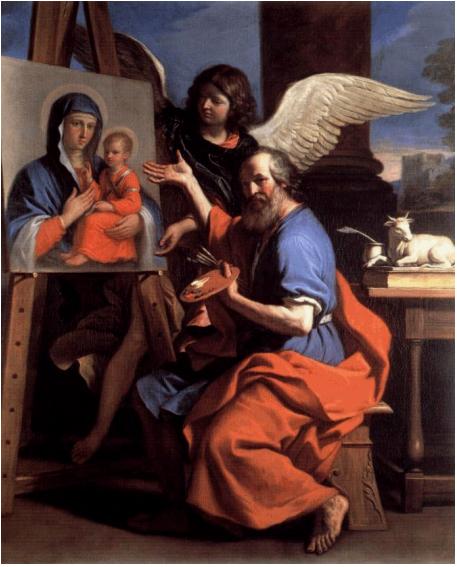
St. Luke the Evangelist, Patron Saint of Artists!

"ST. LUKE, a physician at Antioch, and a painter, became a convert of St. Paul, and afterwards his fellow-laborer. He is best known to us as the historian of the New Testament. Though not an eye-witness of Our Lord's life, the Evangelist diligently gathered information from the lips of the apostles, and wrote, as he tells us, all things in order. The acts of the Apostles were written by this Evangelist as a sequel to his Gospel, bringing the history .of the Church down to the first imprisonment of St. Paul at Rome. The humble historian never names himself, but by his occasional use of "we" for "they" we are able to detect his presence in the scenes which he describes. We thus find that he sailed with St. Paul and Silas from Troas to Macedonia; stayed behind apparently for seven years at Philippi, and, lastly, shared the shipwreck and perils of the memorable voyage to Rome. Here his own narrative ends, but from St. Paul's Epistles we learn that St. Luke was his faithful companion to the end. He died a martyr's death some time afterwards in Achaia."
- Lives of the Saints, by Alban Butler (1894 edition)


"According to tradition he was an artist, as well as a man of letters; and with a soul alive to all the most delicate inspirations, he consecrated his pencil to the holiest use, and handed down to us the features of the Mother of God. It was an illustration worthy of the Gospel which relates to the divine Infancy; and it won for the artist a new title to the gratitude of those who never saw Jesus and Mary in the flesh. Hence St. Luke is the patron of Christian art."

- The Liturgical Year, Dom Gueranger O.S.B.

Saturday, October 17, 2009

Most Sacred Heart of Jesus, Have Mercy on Us!

"[T]he Heart of the Incarnate Word is deservedly and rightly considered the chief sign and symbol of that threefold love with which the divine Redeemer unceasingly loves His eternal Father and all mankind.
It is a symbol of that divine love which He shares with the Father and the Holy Spirit but which He, the Word made flesh, alone manifests through a weak and perishable body, since 'in Him dwells the fullness of the Godhead bodily.'
It is, besides, the symbol of that burning love which, infused into His soul, enriches the human will of Christ and enlightens and governs its acts by the most perfect knowledge derived both from the beatific vision and that which is directly infused.
And finally—and this in a more natural and direct way—it is the symbol also of sensible love, since the body of Jesus Christ, formed by the Holy Spirit, in the womb of the Virgin Mary, possesses full powers of feelings and perception, in fact, more so than any other human body.
Since, therefore, Sacred Scripture and the official teaching of the Catholic faith instruct us that all things find their complete harmony and order in the most holy soul of Jesus Christ, and that He has manifestly directed His threefold love for the securing of our redemption, it unquestionably follows that we can contemplate and honor the Heart of the divine Redeemer as a symbolic image of His love and a witness of our redemption and, at the same time, as a sort of mystical ladder by which we mount to the embrace of 'God our Savior.'"
- HAURIETIS AQUAS (On Devotion To The Sacred Heart) Pope Pius XII, May 15, 1956


ACT OF ADORATION TO THE SACRED HEART 
by St. Margaret Mary Alacoque

With all the power of my heart, I now adore Thy sovereignty, O most Sacred, Divine and Adorable Heart of Jesus, whom I wish to fear and respect with continuous attention never more to offend Thee because Thou art infinitely good. O most Sacred Heart, I love Thee and wish to love Thee above all things with all my strength and power. I detest every mortal sin and all voluntary venial sins; I hope that as we belong to Thee, who hast given birth to us on the Cross with so much pain, Thou wilt have pity on our weakness and misery and not allow us to perish.

I offer myself entirely to Thee, O Heart of love, with the intention that my whole being, my life and my sufferings may be employed in loving, honoring and glorifying Thee in time and in eternity. I love Thee, O most amiable Heart, as my sovereign good, my entire happiness and all my joy, as the sole object worthy of the love of all hearts. May my heart be reduced to cinders by the ardor and vehemence of this love, by which I renew with my whole soul all the offerings which I have made to Thee of myself. Keep me from displeasing Thee and grant me to do what is most pleasing to Thee. O Heart, Source of pure love, would that I might be all heart to Thee and all soul to adore Thee! Grant that by Thy holy grace, I may be able to love only Thee, to love in Thee and by Thee and for Thee. May my memory think only of Thee, may I have no other understanding but to know Thee, no other will or affection but to love Thee, no tongue but to praise Thee, no eye but to see Thee, no hands but to serve Thee, no feet but to seek Thee, in order that I may be able one day to love Thee without fear of losing Thee for all eternity. Amen.

St. Margaret Mary Alocoque, Patron of Devotees of the Sacred Heart

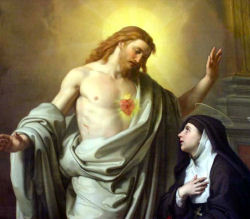
"MARGARET MARY was born at Terreau in Burgundy, on the 22d July, 1647. During her infancy she showed a wonderfully sensitive horror of the very idea of sin. In 1671 she entered the Order of the Visitation, at Paray-le-Monial, and was professed the following year. After purifying her by many trials, Jesus appeared to her in numerous visions, displaying to her His Sacred Heart, sometimes burning as a furnace, and sometimes torn and bleeding on account of the coldness and sins of men. In. 1675 the great revelation was made to her that she, in union with Father de la Colombière, of the Society of Jesus, was to be the chief instrument for instituting the feast of the Sacred Heart, and for spreading that devotion throughout the world. She died on the 17th October, 1690.
Reflection.—Love for the Sacred Heart especially honors the Incarnation, and makes the soul grow rapidly in humility, generosity, patience, and union with its Beloved."
- Lives of the Saints, by Alban Butler (1894 edition)


In one of her visions of Christ, St. Margaret Mary received 12 promises for those devoted to to the Sacred Heart of Jesus:
  1. I will give them all the graces necessary for their state of life.
  2. I will establish peace in their families.
  3. I will console them in all their troubles.
  4. They shall find in My Heart an assured refuge during life and especially at the hour of their death.
  5. I will pour abundant blessings on all their undertakings.
  6. Sinners shall find in My Heart the source of an infinite ocean of mercy.
  7. Tepid souls shall become fervent.
  8. Fervent souls shall speedily rise to great perfection.
  9. I will bless the homes where an image of My Heart shall be exposed and honored.
  10. I will give to priests the power of touching the most hardened hearts.
  11. Those who propagate this devotion shall have their names written in My Heart, never to be effaced.
  12. The all-powerful love of My Heart will grant to all those who shall receive Communion on the First Friday of nine consecutive months the grace of final repentance; they shall not die under my displeasure, nor without receiving their Sacraments; My heart shall be their assured refuge at that last hour.

Thursday, October 15, 2009

Celebrating a great feast for Carmel!

JMJT
Jesus+Mary+Joseph+Teresa


"We shall never learn to know ourselves except by endeavoring to know God; for, beholding His greatness, we realize our own littleness; His purity shows us our foulness; and by meditating upon His humility we find how very far we are from being humble."
 - St. Teresa of Avila


St. Teresa was born on March 28, 1515.  At the age of 20, she joined the Carmelite Convent of the Incarnation in Avila.  In 1562, St. Teresa founded the Convent of St. Joseph where she proceeded to begin the reform of the Carmelite order.  For this reason, St. Teresa and St. John of the Cross are known as the founders of the Discalced Carmelites.  Before her death in 1582, St. Teresa founded 32 convents throughout Spain.
St.Teresa was blessed with mystical experiences including visions of Our Savior and a piercing of her heart by an angel.  These mystical experiences led her to a profound knowledge of the Divine for which she was named a Doctor of the Church.


"Let nothing disturb you; Let nothing frighten you. All things are passing. God never changes. Patience obtains all things. Nothing is wanting to him who possesses God. God alone suffices."
- St. Teresa of Avila

St. Teresa, pray for us!


Some excellent reading: 
The Life of Teresa of Jesus (Autobiography)
The Interior Castle by St. Teresa of Avila